Passion * Technology * Ruthless Competence

Thursday, August 27, 2009

The Last Mile of the Internet

Christian Weyer makes a great comment on yesterday’s post about the barbarian rediscovery of async messaging:

But how do these two toolkits solve the NAT/Firewall issue? Without a solution to this they are pretty much useless in breadth usage.

Simply put, they don’t. Frankly, they don’t even try. And I agree with Christian that the NAT/Firewall issue makes any async messaging based approach useless for clients. It’s kind of like the last mile problem in the telco/cable industries – you’ve got this great capability in the center, but you can’t leverage its full potential because of the massive effort it takes to push that capability all the way to the edge of the network.

Dave Winer has been pretty explicit with his RSS Cloud work: “The goal is to have a Small Pieces Loosely Joined equivalent of Twitter.” PubSubHubbub doesn’t mention Twitter by name, but the protocol spec specifically says “Polling sucks. We think a decentralized pubsub layer is a fundamental, missing layer in the Internet architecture today”. Both specs have a fundamental design that looks like this:

image

This picture leaves out multiple publishers and subscribers and the subscriber registration process, but you get the basic idea. And it all works great assuming that both the subscriber and the pub/sub infrastructure can accept incoming connections. While that seems like a fairly safe assumption for infrastructure pieces, it is clearly a faulty assumption for any subscriber running locally on a client machine. Client machines primarily live behind firewalls at the office, behind NAT routers at home or on mobile wireless network – all of which disallow most if not all incoming connections. In other words, this works just fine for server subscribers (like, say Google Reader) but not for client subscribers (like, say TweetDeck).

image

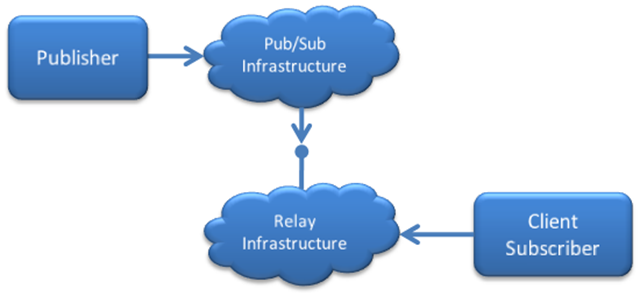
As far as I can tell, the only way to enable client subscribers to play in this async messaging world is via some type of relay service. Any other solution I can think of depends on mass adoption of new technology, which as I mentioned in my last post is nearly impossible.
image

In this approach, the client subscriber makes an outbound connection to some type of relay infrastructure, which in turn creates a endpoint on the public internet for that client. Registration for pub/sub happens as normal, using the relay endpoint as the notification URL. Then, when a message arrives on the relay endpoint, it’s sent back down the outbound connection to the client.

The relay approach is technically feasible – it’s used in many places today. Exchange DirectPush uses this approach to support real-time delivery of mail to mobile devices – though the relay capability is built directly Exchange client access servers rather than available as a separate service. The .NET Service Bus – part of Windows Azure – provides a hosted relay infrastructure that anyone can leverage (though their support of non-windows platforms is pretty weak). I haven’t worked with it, but it looks like Opera’s new Unite platform includes a relay service as well (note, they call it a proxy service). Nice thing about Opera Unite is the async messaging infrastructure is built right into their browser, though you could achieve something similar in any browser using Flash or Silverlight.

Yes, having to relay messages sucks. But the question is, which sucks worse: polling or relaying?

Posted By Harry Pierson at 11:08 AM Pacific Daylight Time
Thursday, September 03, 2009 1:32:58 AM (Pacific Standard Time, UTC-08:00)
How about using Jabber (or alike) protocol for relaying?
It works in distributed way just like email, while it has real-time capabilities, also each user can have infinitely many resource locators (and each user has full control over their addresses), then just setup different apps to listen to a different resource name which is subscribed to whatever publisher.
In the end, if your mail/NAT/whatever-publicaly-facing server is Jabber-capable, you have the real-time relay infrastructure in place already.
Moreover this setup works *everytime* you move your netbook away from home network!
Google uses XMMP even for voice/video communication.
So what are we reinventing?
Marius Mikučionis
Thursday, September 03, 2009 7:05:30 AM (Pacific Standard Time, UTC-08:00)
@Marius I believe that's exactly what superfeedr does
Tuesday, September 22, 2009 11:58:36 AM (Pacific Standard Time, UTC-08:00)
XMPP is still polling. It's not a naive polling, but polling none the less.
With the client behind NAT/firewall, there doesn't seem to be any way around that. It's the client who is responsible for initiating request. Even if one uses smart tricks with multiple mini-requests and responses to emulate biderectional communications. It's still synchronous request/response model under the hood.
On the other side, if network lattency is low, client and server resources are abundant, and there is no true real-time requirements (all of which is typically the case for all the "webby" things), it should suffice for quite a few (if not most) usage scenarios.
Lo'sos'
Comments are closed.
Change Congress
Recent Bookmarks
Tags .NET Framework (2) __clrtype__ (9) ADO.NET (5) Agile (7) AJAX (3) Architecture (288) Guidance (6) Interop (2) Modelling (61) Patterns (7) Process (4) SOA (94) Web Services (5) ASP.NET (25) Async Messaging (2) Azure (1) Battlestar Galactica (3) BI (2) BizTalk (4) Blogging (117) dasBlog (11) Podcasting (4) BPM (1) C# (11) C++ (4) Capitals (5) CardSpace (3) CLR (2) CodePlex (1) College Football (10) Comedy Central (1) Community (81) Concurrency (6) Consumer Electronics (1) Database (13) Debugger (23) Dependency Injection (2) Development (122) C Plus Plus (1) Embedded (5) Lanugages (42) Media (2) P2P (11) Rotor (1) SharePoint (6) SOP (3) DIY (1) DLR (25) Domain Specific Languages (15) Durable Messaging (5) Dynamic Languages (12) Dynamic Silverlight (1) Education (3) Enterprise 2.0 (1) Entertainment (14) ETech (15) F# (51) Functional Programming (17) Game Development (2) Guidance Automation (3) Hardware (8) HawkCodeBox (1) HawkEye (3) Health (1) Hockey (31) Home Electronics (1) Home Network (5) Hosting API (1) Humor (5) IASA (1) Idempotence (3) infrastructure (5) Instrumentation (4) Integration (2) IronPython (112) IronRuby (16) Java (2) Job (3) Kodu (1) LangNET (2) Lightweight Debugger (5) LINQ (23) Live Framework (3) Live Mesh (2) Lost (1) Master Data Management (1) Media 2.0 (6) Microsoft (31) MIX06 (2) Mobile Phone (1) Monads (5) Morning Coffee (172) Object Oriented (4) Office (5) Open Source (8) Open Space (2) Operations (3) Other (135) Art (1) Books (1) Family (33) Games (18) General Geekery (27) Home Theater (1) Movies (23) Music (20) Politics (3) Society (1) Sports (37) Working at MSFT (19) Parallel Programming (3) Parsing Expression Grammar (16) patterns & practices (2) PDC08 (5) Politics (48) Polyglot (3) PowerPoint (2) PowerShell (39) Presentation (7) Projects (1) HawkWiki (1) Pygments (5) Python (6) Quote of the Day (4) Refactoring (1) Research (2) REST (18) Reuse (5) Robotics (2) Rock Band (4) Rome (5) Ruby (23) Ruby on Rails (1) Sci-Fi (2) Scripting (4) Security (3) Service Broker (14) SharePoint (2) Silverlight (20) Social Software (1) Software + Services (2) Software Design (2) Software Engineering (1) Software Factories (11) Software Industry (1) Space Elevator (1) Spark (1) SQL Server (2) Stephen Colbert (1) TechEd (7) TechEd06 (1) TechRec League (1) Television (6) Travel (7) Unified Client (1) Unit Testing (4) USC (1) UX (1) Virtual PC (2) Visual Basic (3) Visual Studio (20) Volta (2) Washington Capitals (37) WCF (31) Web 2.0 (67) Web Services (7) WF (21) Windows (3) Windows Live (29) Windows Live Writer (3) WPF (8) Xbox (1) Xbox 360 (54) XML (11) XNA (15) Zune (4)
Disclaimer: The information in this weblog is provided "AS IS" with no warranties, and confers no rights. This weblog does not represent the thoughts, intentions, plans or strategies of my employer. It is solely my opinion. Inappropriate comments will be deleted at the authors discretion.